
Nonfiction authors: maximize your voice using this trio of interview rules. (They also work for novelists, scriptwriters, and other scribes.)
Your book is published and you're ready to spread the word

Enjoy this guest post by my longtime friend and colleague, Arnie Bernstein, the second author I published early in my publishing career. Over the years he’s become an engaging talking head and a media pro, and I’m proud to present his top 3 rules for interviews. Find him on on Substack at The Typewriter’s Collage.
Our lives in the writing trade are a paradox. We must hermetically seal ourselves away from the rest of the world to get our books from Draft One to Draft Done. In the heat of creation, we must become an agoraphobic’s agoraphobic. Conversely, once the book is completed we must be an extrovert’s extrovert. Connecting with professionals in the publishing racket is paramount. We need agents, editors, proofreaders, and so many others. Most of all, we must have readers.
Social media is a proven method to to connect with your audience. “BookTok” anyone? There’s lots of great advice on using social media to your advantage. I’ll let experts on that do the talking. They’re easy enough to find.
Modesty, shmodesty. Your Book Isn’t Going To Sell Itself
There’s no such thing as shameless self promotion. I like to joke that when I became a writer I got the word “W H O R E” tattooed on my chest. I’ll talk to almost any and everyone who wants to interview me, be it traditional or new media, students, librarians, book clubs, and other venues. I’m no good at percentages or statistics, but for grins let’s say that I’ll give a “yes” to 99.99 percent of all interview requests. Social media, while seemingly limitless, can get you lots of “likes.” Up close and personal, even over Zoom, is by far my preferred method of connecting with both established and potential readers. In my estimation, nothing casts a larger net than a great interview.
Book promotion is no place to be humble. Any request or pitch you make for an interview must emphasize that you are the expert. This non-humble brag applies to every venue where you can market your books: libraries, podcasts and radio shows, television, documentaries, newspapers and blogs, you name it. My footprint is enormous, and without ever leaving the house. I’ve been interviewed throughout the United States, plus media outlets in Australia, England, Ireland, Israel, Poland, and more. Some of my notable interviews include Q&As with NPR, PBS, MSNBC, BBC-Radio, The New York Times, The Washington Post, The Times of Israel, and German public television. I’ve even been interviewed by RT, aka “Russia Today.” And no, I wasn’t spreading propoganda for Putin, thankyouverymuch.
Consider now my three cardinal rules for getting and giving interviews. I’m a narrative nonfiction guy to the core, but you can tweak these axioms to fit your genre, be it biography, how-to, fiction, or script work.
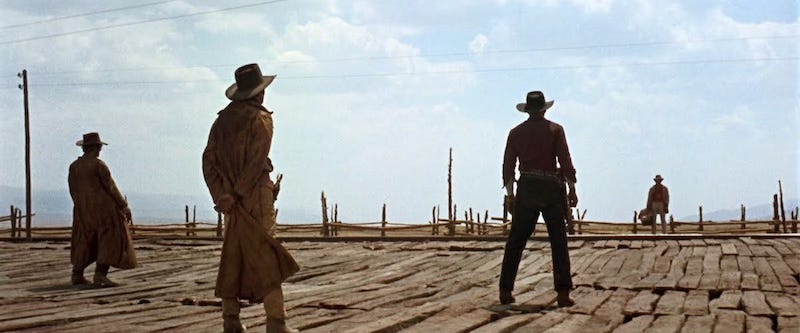
In homage to spaghetti western maestro Sergio Leone, let’s call this triad of interview rules “The Good, the also Good, and the Ugly pivoted into Good. ”
Rule 1: Get out there
I’ve received many an interview request thanks to my internet hangout, www.arniebernstein.com. You want a great website to best trumpet your books, what you bring to the table, and how people can connect with you. Keep in mind that golden rule of commerce: you get what you pay for. I urge you to avoid “free” web hosting platforms, which come at a steep cost. They’re run by mega-companies looking to make lots of money, a chore they pass along to you. Your “free” website might get pockmarked with clickbait ads. It’s not a great look. The author website is your internet calling card. Don’t sell yourself short by selling someone’s product.
At the least, buy your own domain name. A “free” URL like “www.free-web-site for-great-author.com/lots-of-gobbleydeegook” is amatuer night without a whiff of accomplishment. A “www.your-name.com” URL tells hosts and producers you’re a serious author who can deliver an engaging interview.
But I’m a writer, not a designer!
Don’t panic if you can’t afford a professional web designer. Many web hosting platforms provide you with simple templates, which makes design easy. As an added bonus, a build-it-yourself website puts you in charge. I do my own web design. I don’t want to be dependent on someone who may not be available when I most need their help.
I use Wix as my hosting service. Their choice of templates and drag-and-drop tools makes it easy for non-designers like me. My website has videos, PDFs to download, links to good resources, places to buy my books, plus different ways for people to contact me. Best of all, I’m webmaster of my domain.1 (NOTE: I’m not endorsing Wix. There’s plenty of good hosting sites out there. Compare and contrast for yourself. That’s how I settled on Wix as my best fit.)
Rule 2: Say “yes” to (nearly) every interview opportunity
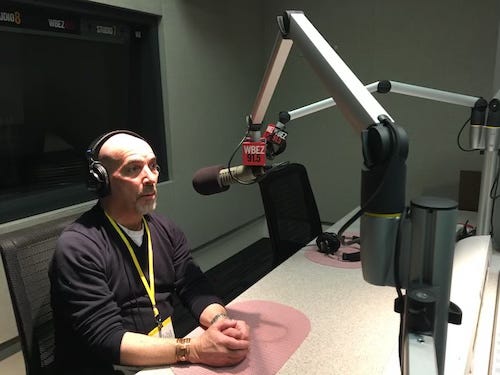
I rarely turn down requests for interviews. Nothing is too large nor too small. I’ll be honest. It’s a kick seeing my wisdom in the pages of The New York Times or on the airwaves of BBC Radio. It’s a great ego stroke. More important, being interviewed by well-known outlets bolsters my role as the expert on the different topics of my books. That goes a long way in getting more interviews. You do a good job, a producer from another outlet hears about it, and bingo! You get a new request for another interview. Onward and upward.
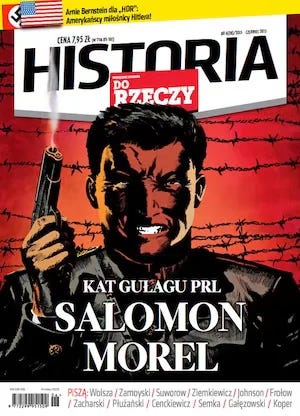
So-called “legacy media” venues like NPR or The Washington Post come with enormous built-in audiences. That’s great, but don’t dismiss smaller venues. I’ve done several interviews with my local newspaper. Those seemingly little outlets are a great way to generate big sales. People get a kick out of knowing someone in their neighborhood is a bonafide author. The attention generated through subsequent word of mouth can turn into indie bookstore events, library speaking gigs, and being a very special guest star for a community book club. Book buyers all.
I also enjoy interview requests by students. I’ve spoken with dozens of school newspapers, from elite universities like Northwestern and DePaul, community colleges, and even my high school alma mater.2 Today’s J-Schooler is tomorrow’s professional. A student interviewer could potentially contact you long after graduation, when they’re working for a major outlet. You never know what opportunities will come your way.
And don’t forget the perks
Besides selling books, there are other cool benefits that come with the “say yes” rule. In my case, that includes all-expense paid trips to New York and Los Angeles for documentary interviews based on my book Swastika Nation: Fritz Kuhn and the Rise and Fall of the German-American Bund. Production companies pick up your tab for airfare, food (you’ll eat well), taxis and ride-shares, plus hotel if overnight stay is required. Same goes for conferences, which twice earned me trips to Connecticut. I’ve traveled to many other states on someone else’s dime. Also, there are oodles of goodies to be found in your guest swag bags. You get the idea.
You can’t handle the truth!
I have turned down the occasional request for an interview when I feel it is not in my best interest. Take my narrative nonfiction book Bath Massacre: America’s First School Bombing, the story of a madman who blew up a rural Michigan school in 1927, killing thirty-eight children and six adults (including both himself and his wife). After the December 12, 2012 mass murder at Sandy Hook Elementary School in Newtown, CT, I was contacted by numerous media outlets. As author of the book on America’s deadliest school killing, people wanted my perspectives on this new mass murder of elementary school kids. I was glad to do it, emotionally draining though these interviews were. I felt I owed it to the victims, doing my part to honor their lives in the wake of yet another flashpoint of inexplicable violence.
I did a lot of interviews over the course of the week, but there was one request I declined with no hesitation. It was an email pitch from a host who told me his show explored contemporary issues “from a nontraditional Christian perspective.” That clause was a red flag. One look at his website made my decision an easy “no freakin’ way.” This podcaster lurked in the odious muck of conspiracy theories. He knew the “truth” about 9/11, the interconnected machinations in the planning and execution of the assassination of President John F. Kennedy by the CIA, the Mafia, Castro, and Rosicrucians. All this plus an encylopediac knowledge of the multifaceted chicanery for both the Freemasons and the Illuminati.
Thanks, no thanks and sorry, not sorry.
Rule 3: Maintain control. It’s your book and your interview.
Rule 2 leads to Rule 3: Stay on point, particularly with live broadcasts and recorded podcasts over which you have no control when it comes to the final product. You’re promoting your book. Interviewers want quality guests. Authors and radio/podcast hosts have a nice symbiotic relationship.3
That said, not all interviewers know what they’re doing. Either that, or they know exactly what they’re doing. Personal axes are to be ground, using you and your book as the mill. I’ve been through multiple wringers with both these scenarios. Enjoy the following war stories, one good and two infuriating. All three tested my will power within the strict confines of live broadcasts.
Book? What book?
I did a phone interview for my book The Movies Are: Carl Sandburg’s Film Reviews & Essays 1920–1927 with a husband and wife team at a small town Iowa radio station. Within thirty seconds, it was clear neither of them read the book—or even knew what “The Movies Are” was about.
I went into quick improvisation mode, taking charge of the situation. In essence, I gave a library talk on live radio, discussing Sandburg’s forgotten work as a thoughtful newspaper film critic during the silent movie era. The hosts periodically jumped in with lots of surprised “oooohs” and “ahhhhhs.”
I worked the problem to my advantage. Listeners spent quality time with a passionate author who knew his stuff, plus I made the hosts look good, something they should have been doing for me—and which they inadvertently accomplished. What could have been a flop turned into a great interview. You must be assertive and nimble-minded, particularly when the going gets tough. There’s a lot of interviewers out there who haven’t read your book but both want and need you to fill their airtime.
Blindsiders
Now two darker lessons in taking control of an interview, nightmare scenarios where both hosts leaped hard and fast off the rails.
After the Sandy Hook shooting, I was booked as a guest for (among other venues) a morning radio show broadcast in Detroit. Unlike the example above, where the “host” was a unhinged conspiracy theorist, this program seemed legit. The station was in Detroit, a seeming natural fit for my book given the Michigan setting of Bath Massacre. They were also an affiliate for a major network. Perfect. The producer booked me at the top of the six o’clock hour, which was my five o’clock. Not my favorite time of day to talk books, particularly books about the mass murder of children, but I followed Rule 1: get out there. And never mind that it’s insane o’clock in the morning.
As background, the killer in my 1927 story used one hundred pounds of dynamite to blow up the north wing of the Bath Consolidated School. The Sandy Hook murderer used an AR-15 semi-automatic rifle in his deadly shooting spree.4
In the days following Sandy Hook, there were renewed cries for sensible gun control laws, something that always generates polarized hostilities. I hadn’t downed my first cup of coffee of the day when the show began. But I snapped awake with a jolt bigger than my regular excessive morning caffeine fix. “Well,” the host said after I gave a brief summary of the Bath murders, “they didn’t ban dynamite back then, did they?”
The raison d'être of this supposed interview was now crystal clear. Like other right wing talk radio loudmouths, any discussion of gun control was heresy. This interlocutor wanted to manipulate Bath’s collective psychic scar, Newtown’s unbearable fresh heartbreak, and me, the expert on school killings. We were a trifecta to filter his outrage.
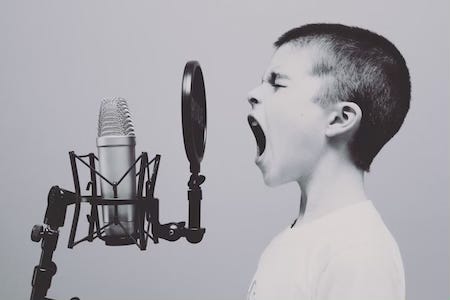
Every fiber of my being screamed “Fuck you, you shtunk! These children were murdered!” I wanted to slam down the phone. My better instincts took over. Rather than read the riot act to this creep with everything he had coming, I parried his blast-furnace rhetoric to what really mattered: the victims. “The world of 1927 is different from the world of 2012,” I replied, my voice in an even tone. “Let’s talk about the tolls these killings have on so many innocent victims and their families.” My evasive action was smooth, but inside I was seething. For the rest of the interview, the host sounded disappointed and more than a little peeved that I hadn’t followed his lead.
A Michigan friend, who heard the show, praised my handling of situation. He told me something I didn’t know beforehand: this bombastic windbag fancied himself as the Rush Limbaugh of Detroit. His intent was to use me as amplification for his caustic braggadocio.
Left or right: wrong
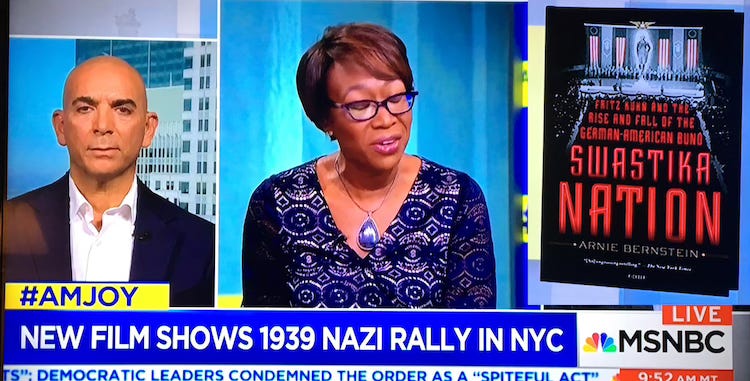
Overwrought jibber-jabber is not the exclusive domain of right wing radio palookas. Consider Joy Reid, the verbose left wing (and now former) MSNBC host, who had me as a guest on her Saturday morning program shortly after the 2017 Charlottesville riots. Ostensibly she wanted to interview me about my book Swastika Nation for a historic5 look at American Nazism.
Instead, Reid displayed a textbook illustration of how a blunt interviewer tries to shove an even-minded interviewee into predetermined talking points. She wanted to parlay my book into an all-out condemnation of Donald Trump (and no, he’s not a Nazi, which is a discussion for another day). I’m no supporter of Donald Trump, but he wasn’t the subject of my book.
This was another case of someone attempting to use me to fit their bill—and Reid wasn’t subtle about her intentions. As with the Detroit windbag, I ignored Reid’s smug attempt to turn me into the mouthpiece for her rhetorical ventriloquism. When Reid went into her mode of “you agree with me so repeat what I said,” I pushed back. I brought the conversation back to the German-American Bund, which is why I was booked as a guest. Or at least that’s what the producer told me.
In summation
You want quality interviews to introduce yourself and your book to new audiences. Be professional in your outreach. Major players are a goal, but so are smaller venues of all sorts. Don’t turn down (almost) anything. Stay true to your work with laser focus on what matters most. Politely override agendas of interviewers turned interrogators. You didn’t toil long days and nights in near solitude to be exploited by gasbags spouting snub-nosed polemics. Audiences will understand—and you’ll come off all the better.
Stick with my three rules.
Get out there.
Say “yes” to (nearly) every interview opportunity.
Maintain control. It’s your book and your interview.
You’re an accomplished author with something to say and a book to sell. That’s your bottom line for any interview, the good, the also good, and the ugly pivoted into good.
Full stop.
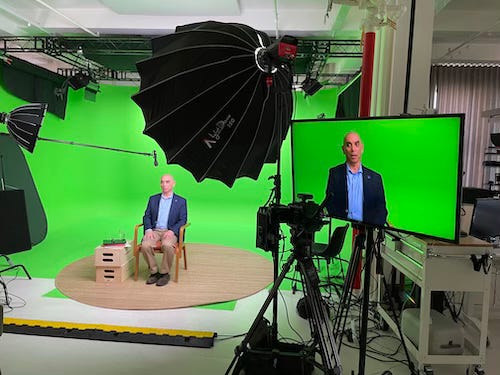
Arnie Bernstein’s research and writing focuses on stories lost in the cracks of time, particularly the forgotten tales of American history. That’s the driving force in his books Swastika Nation: Fritz Kuhn and the Rise and Fall of the German-American Bund (St. Martin's Press & Picador), Bath Massacre: America's First School Bombing (University of Michigan Press), and three books on Chicago film and Civil War history (Lake Claremont Press). His books earned praise from readers and critics alike, including Publisher’s Weekly, Kirkus Reviews, The New York Times, The Chicago Tribune, and others.
Chicago is his hometown. He’s an avid runner, amateur ukulele player, can recite all the dialog from The Godfather by heart, and is a lifelong fan of the Chicago White Sox, which means he doesn’t have to read The Book of Job. He fervently believe in the philosophy of the great Jewish sage, Groucho Marx: “I must say I find television very educational. The minute somebody turns it on, I go into the library and read a good book.”
 | A guest post by
|
Thanks for letting me share this, Arnie!