
The Most Effective Changes I Incorporated Into My Workday and Business Practices in the Last Twelve Months
What did you figure out for your author life this year that you wish you’d figured out sooner?


This article started as a list I made for myself—an accounting of what had shifted in how I work and build over the past twelve months—and I share it and expound on it because the impact hasn’t been small.
A New Relationship with My To-Do List
After years of constant experimenting, adjusting, and paying attention to how I actually work versus how I think I should work, I’ve finally arrived at something that feels (almost) just right, and I (mostly) enjoy a functional, peaceful relationship with my to-do list.
When a new idea surfaces or a new task or outreach suggestion occurs to me, I don’t drop what I’m doing to pursue it. I schedule it. This sounds simple and it is, but the discipline of it has changed the quality of my workdays considerably. Things get captured, nothing gets lost, and my attention stays where I put it.
I’ve also gotten better at sitting with a task—instead of immediately avoiding or rescheduling what I don’t feel like doing, I try staying present with it and give it a good think, some attention. What am I capable of here? What’s the end goal? What does this task actually require? What am I willing to do even if I don’t feel like it? I work on not resisting it and see where that gets me.
And I’ve more or less cracked the code on the right number of tasks for me on a given day. Not an aspirational number. Not getting a little bit done in the dozens of open category tabs I have in my head (and in writing). A real number that fits how I work, what I can do well, and what I can finish. When the list is done, I’m done. Or it’s 2:30 or 3:00pm or I feel like stopping. These are now all legitimate in my burnishing a pre-semi-retirement schedule. In both cases I’m protecting my time and my energy and trusting in something I’ve earned the right to trust: I’ve been at this a long time. What I accomplish in a workday is enough. I will show up tomorrow and pick up where I left off.

Giving Away Books: The Thought Leader Business Model
Seven months (see article below) into doing five things a day every day on behalf of my 2025 book The Profitable Author: 1,001 Ways to Build a Business You Love Around Your Books—pitching, outreach, events, media, all of it—something clicked. The best use of my books wasn’t selling them one or a few at a time. It was giving them away strategically to potential coaching and consulting clients, to organizations that might buy in bulk, to people whose work intersects with mine in ways that could become something.
This is consistent with the thought leader business model—one in which the book isn’t primarily a revenue source but a credential, a calling card, the establishment of expertise, a relationship opener. So far I’ve identified 15 common business model templates that serve as a basis for different kinds authors building businesses. And for mine, consistent with the thought leader model, giving books away generates more revenue than selling them does. A book in the right hands leads to a coaching engagement, a consulting project, a bulk order, a speaking invitation. The book costs me a few dollars, shipping them a few bucks more. The relationships that opens, the solidified reputation, are worth multiples of that expenditure.
I now give away 3–5 books every week, by design, either in person or through the mail, but always accompanied by a customized message and a follow-up. Each giveaway is an investment not a loss.


Reaching Out to One New Interesting Person a Week
Toward the end of last year I committed to reaching out to one person each week that I’d wanted to know or know better, and proposing coffee or lunch—people whose work, projects, and abilities interest me, many operating at a level I’m growing toward or doing things I want to understand better. Often they are people I feel a bit uncomfortable reaching out to. What will they think? What if they say no? So far, 23 out of 29 people I’ve invited have said yes. First, this practice has made me increasingly comfortable with this type of reaching out, handily reinforcing it. Second, the conversations have shifted how I think about my own businesses, revealed risks and opportunities I hadn’t considered, opened lines of communication and partnership possibilities, yielded referrals in both directions, and reminded me that most people doing interesting things are happy to talk to others people doing interesting things who are sincerely curious about them.

Telling People What I’m Up To
Telling people what you’re working on, while you’re working on it, is one of the most underrated business practices I know. The fear that someone will steal your idea is almost always misplaced: Ideas are a dime a dozen—it’s the execution that’s expensive in time, resources, money, and sustained effort. The person across the table from you is so very not likely to give up their mountain of unexecuted ideas to take on yours. What’s far more likely is that they help you—not always immediately, but eventually. Someone you tell about a new project in October remembers it in February when they meet exactly the right person. Someone who hears about your new service passes your name along six months later when a colleague needs it. The weekly meetings I committed to (see above) notably accelerated this for me. More people knowing what I’m building means more people with the context to help when the right moment arrives. Regularly tell people what you’re working on and you’ll be compounding the conditions for serendipity.

Who Not How
Dan Sullivan’s concept from his book Who Not How is deceptively simple: When you face a challenge or a new project, stop asking how you could or should do it, what you’d need to learn, what tool you’d need to master. Ask instead who already knows how to do this well. Who can do it with you or for you?
I’ve been working on applying this more deliberately the last few months (it doesn’t come naturally!) and it’s changed how I think about building. Building my businesses and projects, but also team building. Kristoffer, who has been helping me for over a year, has taken on significantly more substantive work, and I’ve been working on expanding the client responsibilities of Karen, who has helped me part-time for three or four years now. I’m really working on stopping trying to figure things out myself and getting better at identifying the right person to do it for me before defaulting to doing it myself. This involves a whole lot of trusting others, developing others, and communicating effectively.
And there’s a bigger version of this principle I’’m finding myself ready to return to. When I was much younger and running Lake Claremont Press, I built a real team: two full-time employees, two part-time, and a network of about a dozen regular freelancers. It worked. The press grew. Then somewhere along the way, having weathered the responsibilities of other people’s paychecks through hard years and becoming a mom, I became gun shy about building at that scale again.
Thanks to Sullivan’s insistent messaging, that’s fading a way for me. The portfolio of ventures I’m building— Conspire Creative, Beyond the Margins, S Woodhouse Books (the new branding of my legacy books/project management wing), Storied Hotel Books (see below)—is starting to feel less like a collection of solo projects and more like something that is reaching for a team. I’m not fully there yet. But I’m ready to go back there, armed with Who Not How.
Thirty Minutes Every Weekday on Storied Hotel Books
Storied Hotel Books is the most ambitious thing I’m currently working on—and the one most likely to get crowded out by the urgent, immediate demands of a busy consulting and coaching practice. The past twelve months, I fixed that—by committing 30 minutes every weekday to building it.
Here’s the brief version: Storied Hotel Books is a literary B2B venture that creates original, hotel-branded mystery books that luxury and historic hotels commission and place in their rooms, lobbies, and gift shops as a distinctive, story-driven amenity for guests. The hotels get a unique branded experience that sets them apart. Guests get a great read with a sense of place they can finish in a weekend. I get scalable, recurring revenue built around something we love.
Thirty minutes a day doesn’t sound like much, but compounded over months, it has produced a sample book, a prospectus, FAQs, a contract structure, a pricing model, a website, and an active outreach strategy. None of it would exist if I’d waited for big open block of time that never arrives.
This is the value of chipping away at the next big thing while the primary business runs. Momentum doesn’t require marathon sessions and all-nighter devotion we may think. It can also happen by showing up consistently, doing the next small thing, and trusting that small things compound into something real.
By the way…If you know anyone in the luxury or historic hotel world—owners, managers, hospitality consultants, marketing people, customer experience professionals, or anyone with connections in that space—I’d very much welcome an introduction. And if you have thoughts or ideas that might move this project forward, please reach out. Building in public has its advantages, and this is one of them. This is Who Not How + Telling People What You’re Working On!
Blocking Off Every Other Friday and One Week a Month
This year I made a big decision about my time. And I then committed to it by blocking my calendar all the way through the beginning of 2028. It’s my structural response to something I’ve been noticing in myself and thinking about: The same amount of energy and enthusiasm as I’ve always had but a lot less pressure and lot more lingering. A willingness to linger, a delight in lingering. Sounds weird but the odd word choice best matches my experience. I’m also thinking about all the publishing world and business projects I still want to accomplish in the decades ahead and how I will fit that with the future I want: Enjoying a semi-retired mindset (as free as I want to be) combined with the recognition that I’m not the type to ever fully retire.
Every other Friday and one week a month are now protected: I’m unavailable for coaching sessions, discovery calls, or in-person client commitments of any kind. (For context, I’ve been blocking off Mondays for at least five years to focus on accounting, strategy, and planning—so this is an extension of a practice I already know and love.) In 2027, I upped that commitment to include every Friday on the no-fly list. What happens in that time is up to me and the moment: I know myself. Mostly, I will still work as usual. But I want to increase the chances for and the ease of more traveling, finishing a screenplay I’m slowly writing, and dabbling at the foundations of new business ideas.
The blocked time doesn’t reduce what I produce—it changes the conditions under which my current work happens and that makes everything better.
I Changed My Reading Habits
The last few years, but especially this year, I got more intentional about what I read and how books move through my hands. I started buying and reading books by people I know—friends, colleagues, clients—and then leaving them at Little Free Libraries when I’m done. It’s a concrete, low-cost way of supporting authors, independent bookstores, and other readers simultaneously, and it keeps me connected to what people in my world are writing and thinking about. I also shifted the balance of what I read, moving toward almost as much fiction after decades of weighting heavily toward nonfiction of all kinds. And I’ve been steadily reading down the stack of books that have lived on my shelves for years, finally giving attention to things I bought with good intentions—some 20-30-years ago—and never got around to—including writing from very different eras that brings its own unexpected perspectives, textures, and use of language. A lyrical tour of calculus. A gestalt coaching deep dive. A Pulitzer prize winning history of ideas in America.
The cumulative effect on my business has been real and often surprising. Ideas arrive from the most unlikely places: a 10-book mystery/crime series centered around Acapulco’s first female detective, Malala’s memoir because it was one of only a handful of nonfiction books carried in a tiny Lake Geneva mall store, the most thought-provoking treatise on creativity I’ve ever read, a small press coming-of-age novel that seemed to inadvertently position alcohol as a main character. Reading widely, for a variety of reasons, from a wide range of styles, formats, and publication years keeps the mind from calcifying around what it already knows. Yet another reason to love books is that reading isn’t separate from building a creative business—it’s a critical fuel source.
Tell Us in the Comments
Which of these changes resonates most with where you are in your author business right now? Have you made any similar shifts this year—in how you work, how you protect your time, how you think about building a team? What’s one change you keep meaning to make but haven’t yet? What would it take to finally make it?
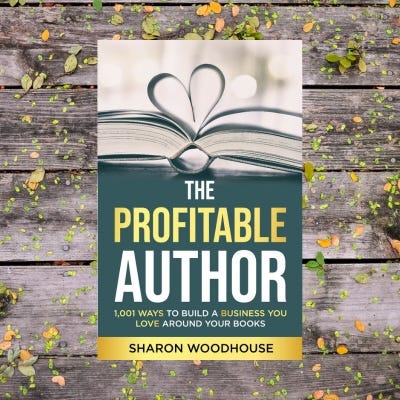
The Profitable Author: 1,001 Ways to Build a Business You Love Around Your Books
If the changes in this article resonate—the systems, the income streams, the mindset shifts, the business model thinking—The Profitable Author is where I’ve codified everything I know about building a sustainable author business after 30+ years in publishing and coaching. It’s a generic marketing guide, nor a one-size-fits-all formula, but tested, practical ways to build the author business that fits your books, your readers, and your life. It’s the same framework, knowledge base, and approach I use with every coaching client, in one book. Get your copy here.
One More Thing
If this kind of honest, field-tested thinking about building an author business resonates with you, there’s a full archive of over 440 articles waiting. Subscribe to get new articles as they publish and access everything I’ve written on author income, business strategy, marketing, mindset, and more—drawn from 30+ years of doing this work.
I love the Storied Hotel concept, but might be biased. 😉