
Experience-Driven Marketing: David Jay Collins Shows How to Merge Creativity and Commerce
How one indie author built partnerships, products, and events around what he loves—while supporting artists and small businesses

A couple days ago, I wrote about Walt Disney’s 1937 Snow White marketing eco-system and what it teaches authors about building business models around creative work.

This came directly from author David Jay Collins, who led our April 16 Beyond the Margins Power Hour on experience-driven marketing with this Disney example—then spent the rest of the hour showing us how it applies to his approach and how we can adopt it for ours. Not at Disney scale, of course, but at indie author scale.
This is David’s indie author ethos: creativity as your greatest asset, starting with what you love, partnerships as win-win opportunities, and building an ecosystem around your books that serves your readers, supports your community, and generates multiple revenue streams.
He gave us great examples from over a decade of author life, six titles and growing. Here’s a summary of his program. Many thanks to him for allowing me to recap his presentation for you.
Creative vs. Commercial: Breaking Either/Or Thinking
We’re conditioned to think of art and commerce as opponents, David said. But what if art and commerce could work together? In fact, they’ve long coexisted (see Disney above). And it’s how he’s decided to approach book marketing and stand out in the market.
It starts with a mindset shift.
You can focus on “conditioned-commerce” thinking:
Poor me, I’m starting with $0.
I have no trust fund, publisher-provided advance, MFA, credentials, or awards.
I can’t lean on a spouse or partner with a big salary.
Credit cards function as my fallback financing.
Without traditional collateral, I can’t access loans or other funding sources.
I’m juggling working full time and writing.
Costs of vending, book printing, and delivery keep increasing.
Many networking events and conferences don’t understand indie authors, include us, or were ever built for us.
There’s a lingering bias: indie author vs. traditionally published author.
This is the scarcity mindset. The I can’t list. The barriers.
Or, you can begin with and return to “creative-freedom” thinking:
That is, reminding yourself that your greatest asset is your creativity.
I can use who I am as an artist to drive my sales and marketing efforts.
I can consider the values I hold closest when creating marketing campaigns and events.
I can incorporate where and how I write into my promotions.
I can use the local businesses where I like to shop as launchpads for event and partnership ideas.
I can realize that my ecosystem is right where I am and build from there.
I can lead with who I want to help succeed in these challenging times.
This is the abundance mindset. The I can and What if? list. The possibilities and opportunities.

David Loves Coffee
David likes coffee. A lot. David writes at indie coffeehouses. A lot.
At some point he realized: Writing itself may not well-suited to social media. Posts about frustration, late nights, endless edits may not be where it’s at, but what about where he writes?
So he started sharing where he writes. Tagging the businesses. Giving them hashtag love. He’s now known for how much he writes at coffeehouses—and he’s fine with that. When I think of David, I think of his big smile and a big cup of coffee decorated with fancy microfoam latte art…cause I’ve seen the happy couple on Instagram oodles of times.
Where you write is part of your creative process. Share your environment. Tag the businesses you frequent and bring them some attention.
David Loves Caramel Corn
David’s Summerdale horror trilogy is set in the Chicago neighborhood of Andersonville, as was the small local sweets boutique, Candyality, one of his go-to shops for his favorite caramel corn. (It has since moved to a different location.)
In 2021, he approached the owner with an idea: Summerdale Crunch. A caramel corn flavor created for and named after his book series, a seasonal combo they still sell from October/Halloween through the Christmas season and on til Valentine’s Day. At times, the store sells gift bundles: One of his books packaged with a bag of Summerdale Crunch. Imagine sitting down to read with a custom-made snack at hand! This is a 5-year partnership that’s still going strong.
David Loves Running
David also loves running, so he contacted the local Read & Run book club (read more below).

He proposed a partnership and they said yes, so he created a route through Andersonville for the group that took the reader-runners through locations from his Summerdale series. The run ended with a book discussion and signing at The Lost Hours, a local coffee shop from which David has posted Instagram content many-a-time.
Talk about breaking the fourth wall. The books’ setting becomes a physical experience and the coffee shop expands further into his ecosystem.
David Loves Candles
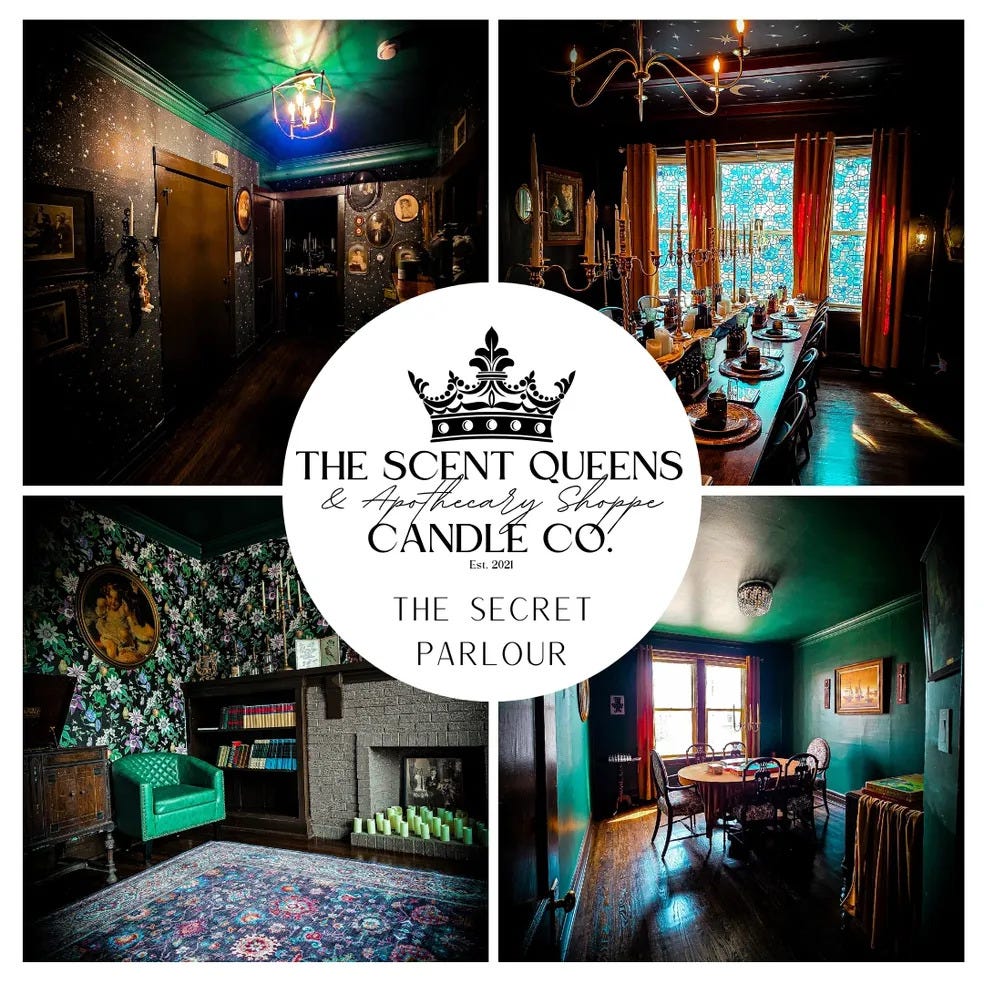
David loves candles and he loves a particular local candle company, The Scent Queens Candle Comapny, which also has a Secret Parlour for events (pictured above). So, not surprisingly, he approached them with a partnership idea. The Halloween-time result bundled a copy of Summerdale, with an author book discussion and signing, snacks and beverages, and a thematically fitting candle in the atmospheric Secret Parlour into one high-priced ticketed event.
Afterwards, David asked the owners: “To celebrate the release of Single & Cooking, Book 2, next June, what would you think of creating a beach-themed candle…?”
Their response: “YES! We would love to!”
A partnership tested and extended. Another product bundle. Another way readers can engage with David’s work beyond his book.
David Loves Supporting Artists
Supporting, elevating, and promoting the artists and indie freelancers who work on his books is also important to David’s approach
He carefully selects graphic artists for his book covers and interior artwork.
His Single & Cooking covers began as paintings.
He uses voice actors for audiobook narration.
He hires indie copy editors for proofreading, cultural sensitivity, continuity.
He lists his collaborators by name across all his books, and promotes them at his booth events.
He promotes artists supporting artists and not using AI in their creative work.
He uses artists to create some of his swag, like limited-edition bookmarks that become bespoke, collectible keepsakes.
Love + Partnerships = His Ecosystem in Action
Every partnership David shared as an example—Candyality, The Lost Hours, The Scent Queens, indie coffee shops—centers locally-owned small businesses. He doesn’t ask for favors cause I’m a customer, he proposes partnerships around things he loves with places he patronizes that bring new customers to their businesses while creating experiences and products around his books.
The result: Multiple touchpoints. Multiple revenue streams. Multiple ways for readers to engage with his work. And all of it grounded in location (his favorite neighborhoods), his values (creativity and supporting locally-owned businesses and artists), and what he genuinely loves (coffee, caramel corn, running, candles).
This is David Jay Collins’s indie author ethos in action:
Your greatest asset is your creativity.
Your ecosystem is wherever you are: where you actually write, shop, run, drink coffee.
Partnerships are win-win. Propose how you can bring new business and attention to others while creating value for your readers and customers.
Support other artists and other small businesses. Promote and credit others.
Disney proved the ecosystem model in 1937. David’s proving it still works…at indie author scale, right now.
Tell Us in the Comments
David ended with his program with: What is your author ecosystem?
What partnerships, products, or experiences have you created (or thought about creating) around your books? What local businesses align with your work or values? What feels realistic for your ecosystem right now?
Our Next Power Hour: Understanding the Tax Side of Your Author Ecosystem
Building partnerships, creating products, running events, generating multiple revenue streams like David demonstrated—all of this has tax implications you need to understand.
On May 14, author and tax professional Michael Haupt will present our next free virtual Power Hour for all authors: In “You’re an Author—Not an Accountant: But Numbers Tell a Story, So What Do You Need to Know About Taxes?” Mike will share his best tax advice for authors and creatives (10-15 minutes of big-picture thinking to the nitty-gritty of write-offs), then we’ll open it up for Q&A with a tax pro who understands author businesses from firsthand experience.
If you’re selling books at events, earning royalties, partnering with local businesses for products, running ticketed experiences, or working with collaborators, you need to know how to track and report this income properly. Mike breaks it down so you can focus on building the ecosystem, not worrying about the taxes. Join us! Thursday, May 14, 1pm-2pm CT. Register here.
This is so creative! As a longtime academic and newbie fiction-writer, I am delighted to be learning from you.
I'm actually curious as to how these revenue streams work for David. Like, is it money upfront? Every purchase? I love the idea of partnering with local businesses, though. All of my soon-to-be-written instalove stories will be based in my hometown and I look forward to building my author ecosystem.